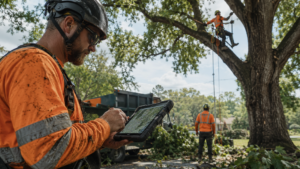
Trees survive wind, heavy rain, lightning, drought, insects, disease, and years of changing weather. Arborists work in many of the same conditions. Their equipment is built for rough terrain, their crews are trained to manage dangerous situations, and their vehicles carry tools capable of handling enormous limbs and damaged trunks. Yet behind many arborist companies sits a surprisingly fragile collection of computers, phones, passwords, spreadsheets, and disconnected software.
That weakness may remain hidden during an ordinary week. The schedule is manageable, calls arrive at a steady pace, and employees can work around the occasional technical problem. Everything changes when a storm rolls through the area. Phones begin ringing, online requests pile up, crews need updated addresses, and customers expect immediate answers. A slow computer, lost password, failed internet connection, or inaccessible customer database can suddenly become as disruptive as a broken chipper.
Information technology includes the systems used to create, store, retrieve, process, and transmit information. For an arborist company, that information includes customer records, estimates, property photos, job notes, crew assignments, invoices, maps, equipment records, and emergency requests. According to IBM’s overview of IT infrastructure, dependable business technology relies on connected hardware, software, storage, and networking components. Those pieces should work together as one durable operating system for the company rather than a pile of unrelated tools.
Arborist Work Has Become Digital Work 🌳
Tree care remains physical, skilled, and highly specialized, but the business surrounding it has moved online. A customer may discover a company through search results, read reviews, submit a website form, upload pictures of a damaged tree, receive an estimate by email, sign an agreement electronically, and pay an invoice from a phone. Before a crew ever starts a chainsaw, several digital systems have already influenced whether the job was won or lost.
This matters because customers rarely separate a company’s technical performance from its overall professionalism. A homeowner who submits a request and receives no response does not know that a notification failed. The customer only knows that the company appeared unavailable. A property manager who receives an estimate with missing information does not see a software synchronization problem. The manager sees an incomplete proposal.
Reliable IT helps arborist companies maintain a consistent experience from the first contact through the final payment. Calls, forms, text messages, estimates, contracts, photographs, and invoices should remain connected to the same customer record. Office staff should be able to see what the estimator promised. Crew leaders should be able to access the correct address, work order, site notes, and safety concerns. Owners should be able to review job status without calling five people to reconstruct the day.
A strong digital system does more than save time. It reduces the small communication failures that slowly damage customer trust.
Storm Response Depends on More Than Trucks and Chainsaws ⛈️
Storm work can create one of the greatest opportunities for an arborist company, but it can also expose every weakness in the business. A company may receive several days’ worth of calls in a few hours. Emergency requests must be sorted by severity, location, access, utility involvement, crew capacity, and potential danger.
A notebook beside the phone may work for ten calls. It becomes unreliable when dozens of people are reporting fallen trees, blocked driveways, damaged roofs, and hanging limbs. Handwritten information can be misread, duplicated, or lost. Text messages may reach one employee while the rest of the team remains unaware of the request.
A durable IT system creates a central record for each incoming job. Office staff can document the address, callback number, damage description, photographs, access limitations, and urgency. Dispatchers can assign work based on location and crew availability. Field employees can update the job from a phone or tablet, allowing the office to provide accurate information when a customer calls again.
Digital reliability becomes especially important when power or internet service is unstable. Cloud-based tools, mobile access, backup connections, charged battery packs, and documented emergency procedures can help the company continue operating. The goal is not to create a complicated technology department. The goal is to prevent one failed device or lost connection from shutting down the entire response effort.
Cybersecurity Protects More Than Customer Data 🔐
Arborist companies may assume cybercriminals are mainly interested in banks, hospitals, and large corporations. Small businesses are still attractive targets because they often store valuable information without maintaining the same security resources as larger organizations.
An arborist company may keep customer names, addresses, phone numbers, email addresses, property photographs, signed contracts, payment records, employee files, insurance documents, and vendor information. Access to the company email account can also expose invoices, password-reset messages, customer conversations, and payment instructions.
The NIST Cybersecurity Framework 2.0 provides organizations with guidance for managing cybersecurity risk through governance, identification, protection, detection, response, and recovery. The framework is designed to support organizations of different sizes and levels of technical sophistication, making its underlying principles relevant to small service companies as well as major institutions.
For an arborist business, practical protection begins with disciplined habits. Employees should use unique passwords, multifactor authentication, updated software, secure Wi-Fi, protected mobile devices, and controlled access to business accounts. Former employees should lose access promptly. Sensitive information should not live indefinitely in personal text messages or on an estimator’s unprotected laptop.
The Cybersecurity and Infrastructure Security Agency’s small-business resources include guidance for developing incident-response plans, protecting against ransomware, and improving basic cyber readiness. A written response plan gives the company a clear path when an account is compromised, a device disappears, or suspicious activity appears.
Lost Data Can Become Lost Revenue 💾
A computer failure becomes expensive when the only copy of important information was stored on that computer. Estimates, customer lists, photographs, bookkeeping records, job histories, and employee documents may represent years of work. Rebuilding that information can take weeks, and some of it may never be recovered.
Backups should be automatic, secure, and tested. Saving files to an external drive is useful only when the drive remains connected, current, protected, and functional. Cloud storage can add flexibility, but it must be configured properly and protected with strong access controls. Important systems may require more than one backup method so that a single failure does not destroy both the original information and its backup.
The Federal Trade Commission’s cybersecurity guidance for small businesses emphasizes protecting networks, information, and business operations from common online threats. The FTC also warns that small companies can lose time, money, and information when cybersecurity is neglected.
Backups also support ordinary business needs. An estimator who accidentally deletes a proposal should be able to recover it. A damaged phone should not erase customer photographs. A bookkeeping error should not require the company to recreate months of records. Recovery should be a planned process rather than a desperate search through old emails and employee devices.
Reliable Systems Keep Crews Moving 📱
Field employees should not need to return to the office for information that could be securely accessed from a mobile device. The right field system can provide addresses, maps, work orders, equipment requirements, customer notes, photographs, completion forms, and schedule changes.
This does not mean every arborist needs a complicated screen filled with dozens of features. Field technology should be simple enough to use while wearing gloves, standing near noisy equipment, or working in poor weather. Too many menus, slow loading times, and unnecessary data entry can turn useful software into another obstacle.
The strongest systems match the company’s actual workflow. A small residential tree-care company may need scheduling, estimating, invoicing, and customer communication. A larger operation serving municipalities or commercial properties may also need asset tracking, recurring maintenance schedules, detailed inspection records, crew certifications, and job-cost reporting.
Reliability should remain a priority when software is selected. The AWS Well-Architected Framework’s reliability guidance describes reliability as the ability of a workload to perform its intended function correctly and consistently when expected. That principle applies beyond large cloud environments. An arborist company’s technology should perform during busy weeks, severe weather, employee absences, and equipment failures, not only when conditions are convenient.
Better IT Supports Local Visibility and Faster Follow-Up 📍
A reliable internal system strengthens external marketing. Local search visibility may bring a steady stream of visitors to the website, but those visitors still need a clear way to request service. A properly connected website can send inquiries directly into a customer-management system, create follow-up reminders, and alert the appropriate employee.
Someone searching for Arborists Near Me is usually looking for a nearby professional who appears credible, responsive, and prepared to handle the work. The company’s website, contact forms, reviews, phone system, email, and scheduling process all shape that impression.
Fast follow-up matters because customers often contact several companies, especially when a tree is damaged or creating a safety concern. Automated confirmation can immediately let the customer know that the request was received. Internal notifications can make sure the inquiry reaches the right employee. Follow-up tracking can prevent a strong lead from disappearing because someone assumed another person had returned the call.
Technology should support personal service rather than replace it. Customers still value knowledgeable conversations, clear explanations, accurate estimates, and dependable crews. Good IT removes the administrative confusion that prevents employees from delivering that service consistently.
Business Continuity Requires Preparation 🛡️
A durable arborist business should be able to continue operating when a laptop fails, an employee leaves, an email account is compromised, or an important application becomes unavailable. That requires documented procedures and shared access controlled by the company.
Critical systems should not depend entirely on one employee’s memory. Account ownership, billing details, administrator access, software subscriptions, backup procedures, vendor contacts, and recovery instructions should be documented securely. The owner should know which systems are essential and how long the business can function without each one.
Microsoft’s guidance on breach prevention and recovery infrastructure connects security planning with business continuity and disaster recovery. It recommends protecting identity systems, maintaining recovery capabilities, and modernizing vulnerable infrastructure.
Regular testing is equally important. A backup that has never been restored remains an assumption. An emergency contact list that has not been updated may be useless. A former employee’s active account may become a security gap. Reviewing these systems a few times each year can reveal problems before they interrupt customer service or field operations.
Tough IT Creates Room for Growth 📈
Arborist companies often add technology one piece at a time. Someone creates a spreadsheet for leads. Another employee chooses a scheduling app. Estimates are stored in email. Photos remain on personal phones. Accounting software contains one version of the customer’s information while the office calendar contains another.
This may work while the company is small, but growth makes the cracks wider. More crews create more scheduling conflicts. More customers create more follow-up tasks. More employees create more passwords and access points. More equipment creates more maintenance records. Without connected systems, the owner spends increasing amounts of time searching for information and correcting preventable mistakes.
Strong IT provides a reliable foundation for expansion. New employees can follow documented processes. Managers can see accurate job information. Owners can review performance without manually combining several reports. Customers receive more consistent communication. The company becomes less dependent on improvisation and individual memory.
Technology should be selected according to business needs rather than trends. The most expensive software is not automatically the best choice, and the newest platform may not fit the company’s workflow. A useful system should reduce duplicate work, improve visibility, protect information, and remain manageable for the people who use it every day.
Conclusion
Trees are built to withstand difficult conditions. Successful arborist companies must develop the same resilience behind the scenes.
Strong trucks, sharp saws, skilled climbers, and trained ground crews remain essential. Reliable IT systems now belong in that same category. Scheduling, dispatch, customer communication, cybersecurity, backups, estimating, invoicing, and mobile access all contribute to the company’s ability to respond quickly and operate professionally.
A tough IT system does not need to be oversized or complicated. It needs to be secure, connected, documented, backed up, and designed around the way the company actually works. When technology remains dependable during storm season, employee changes, equipment failures, and busy periods, the entire organization becomes stronger.
The trees may be tough. The systems supporting the arborists responsible for them should be tougher. 🌲