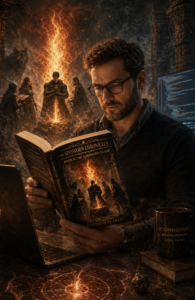
IT consultants spend their careers inside complex systems. They walk into organizations where leadership is strained, technology is tangled, teams are under pressure, and every decision has consequences. They are asked to solve problems that are rarely simple, rarely isolated, and rarely technical alone. That is why the best IT consultants do not only study software, cybersecurity, infrastructure, project management, or digital transformation. They also study leadership, decision-making, human behavior, risk, loyalty, and the pressure that comes when the wrong move can change everything.
That is one reason The Sinsworn Chronicles, Book II: The Forbidden Flame is more than entertainment for consultants, strategists, and technology leaders. Fantasy may seem far removed from cloud migrations, AI governance, cybersecurity planning, ERP rollouts, data strategy, and client advisory work, but strong fiction often reveals truths that business books only outline. A powerful story places characters under pressure, strips away easy answers, and forces readers to watch how people respond when the path forward is uncertain.
For IT consultants who want to sharpen their strategic thinking, leadership instincts, and high-stakes problem-solving ability, this book belongs beside professional development resources, technology trend reports, and leadership material. Readers who enjoy epic fantasy novels often recognize that the genre is built on the same core challenges consultants face every day: competing priorities, fragile alliances, hidden risks, difficult choices, and the need to lead people through uncertainty.
The Connection Between Fantasy Strategy and IT Consulting
At its core, IT consulting is about helping organizations move from confusion to clarity. According to Wikipedia’s overview of information technology consulting, IT consultants advise organizations on how to use technology to achieve business objectives. That definition sounds clean and straightforward, but anyone who has worked in consulting knows the reality is much messier. Business goals compete with budget limits. Security needs compete with convenience. Innovation competes with legacy systems. Leadership wants speed, but teams need stability.
Fantasy stories like The Forbidden Flame are built around similar tension. Characters are forced to make decisions without having every answer. They must read the room, understand threats, protect what matters, and choose a path even when the cost is high. That is exactly what IT consultants do when they help clients navigate a major technology shift.
A consultant may be asked whether a company should move to a new platform, rebuild an internal process, strengthen cybersecurity controls, adopt AI tools, or modernize infrastructure. The answer cannot be based on technology alone. It must account for people, timing, cost, risk, training, leadership readiness, and long-term business impact. In that way, strategic fantasy can sharpen the same mental muscles consultants need in the field.
Leadership Under Pressure Is a Skill Consultants Need
The best consultants are not just technically capable. They are calm under pressure. They can sit in a tense meeting, hear competing opinions, identify the real problem, and guide people toward the next right step. That type of leadership is not developed by memorizing software features. It is developed by studying situations where pressure reveals character.
The Forbidden Flame gives readers a story world where leadership is tested through danger, conflict, uncertainty, and consequence. That matters because IT consultants are often brought in when something important is already strained. A client may be losing productivity because of outdated systems. A company may be dealing with cybersecurity concerns. A leadership team may be unsure how to prioritize technology investments. A business may be growing faster than its systems can support.
Modern technology leadership is moving closer to business strategy every year. McKinsey’s Global Tech Agenda 2026 discusses how CIOs are increasingly shaping enterprise strategy, not simply managing technology. That same shift affects consultants. Clients do not only need someone who understands tools. They need someone who can think like a strategist and communicate like a leader.
A fantasy novel that centers on leadership, loyalty, risk, and courage can help consultants reflect on how leaders behave when plans fall apart. It can remind them that authority is not the same as wisdom, speed is not the same as progress, and confidence is most valuable when it is grounded in clarity.
High-Stakes Problem Solving Requires More Than Technical Knowledge
IT consultants solve layered problems. A broken workflow may point to a software issue, but it may also reveal poor training, weak communication, unclear ownership, outdated processes, or leadership misalignment. A cybersecurity gap may not be caused by one bad tool. It may come from a culture that treats security as an afterthought instead of a shared responsibility.
That is why consultants need pattern recognition. They must learn to look beneath the surface. In The Forbidden Flame, readers are pulled into a story where the visible conflict is only part of the larger problem. The deeper challenge is understanding what is hidden, what is changing, and what choices will shape the future.
That kind of thinking connects directly to IT consulting. Consultants must ask what is really happening inside an organization. They must identify which problems are urgent, which are symptoms, and which are root causes. They must help clients avoid decisions that feel productive in the moment but create bigger problems later.
Cybersecurity is a strong example. The NIST Cybersecurity Framework gives organizations a structured way to understand, manage, and reduce cybersecurity risk. A strong consultant does not treat that kind of framework as a checklist only. They use it as a lens for decision-making, communication, accountability, and long-term resilience. In the same way, a strong fantasy narrative teaches readers to think in systems, consequences, and relationships.
The Forbidden Flame Reflects the Reality of Complex Systems
Every IT consultant works inside complex systems. There are systems made of software, servers, data, networks, devices, integrations, and applications. There are also systems made of people, habits, incentives, fears, and expectations. Most consulting problems involve both.
That is one reason fantasy can be so useful for strategic thinkers. A well-built fantasy world has rules, history, power structures, alliances, and consequences. When one part of the world changes, other parts respond. Readers learn to track cause and effect. They learn to pay attention to what is said, what is hidden, and what is implied by someone’s choices.
In IT consulting, this is essential. A new system can change how employees work. A new security rule can create friction if people do not understand the purpose. A new automation tool can save time, but it can also expose weak data practices. A digital transformation project can look successful on paper while failing in adoption.
That is why resources like CIO’s coverage on accelerating digital transformation often focus on leadership, governance, and cross-functional alignment, not only technology. The same principle appears in strong storytelling. The biggest conflicts are rarely solved by one weapon, one rule, or one powerful person. They are solved through strategy, discipline, trust, sacrifice, and timing.
Consultants Need Better Communication, Not Just Better Answers
A consultant can have the right answer and still fail if they cannot communicate it clearly. Clients need to understand the “why” behind the recommendation. They need to see the risk, the opportunity, the tradeoff, and the next step. They need language that makes the complex feel manageable.
Reading fiction can strengthen that skill. Stories train the mind to follow emotion, motivation, and perspective. The Forbidden Flame can help consultants remember that people do not make decisions based on data alone. They make decisions based on trust, fear, urgency, hope, and belief in the person guiding them.
In consulting, this matters deeply. A recommendation to improve cybersecurity may be technically correct, but if the client sees it only as cost, it may be delayed. A recommendation to modernize infrastructure may be wise, but if employees feel ignored, adoption may suffer. A recommendation to implement AI may sound exciting, but without governance, training, and accountability, it may create confusion.
That is why communication is part of strategy. Consultants must translate complexity into language that executives, managers, employees, and stakeholders can act on. They must tell the truth without creating panic. They must inspire action without overselling. They must make the client feel supported, not overwhelmed.
Risk, Security, and Responsibility Are Central Themes for Modern IT Leaders
Today’s IT consultants are working in a world where risk is constantly evolving. Cybersecurity, AI, compliance, privacy, supply chain exposure, and third-party systems are now board-level concerns. Clients need consultants who understand that technology decisions carry serious responsibility.
The CISA Secure by Design guidance emphasizes building security into products and systems from the beginning instead of treating it as an afterthought. That idea also connects to the leadership lessons found in stories like The Forbidden Flame. Wise characters do not only react to danger after it arrives. They prepare, observe, protect, and make decisions based on what could happen next.
Consultants should think the same way. A strong IT consultant does not simply fix what is broken today. They help clients build stronger foundations for tomorrow. They help organizations become more resilient. They challenge short-term thinking when it puts the business at risk. They understand that the easiest path is not always the safest path.
In fantasy, ignoring a warning can change the fate of a kingdom. In consulting, ignoring a warning can lead to downtime, data loss, budget waste, failed adoption, reputation damage, or security exposure. The scale is different, but the lesson is similar: responsible leadership requires foresight.
Why Fiction Belongs in a Consultant’s Professional Growth
Some consultants read only technical documentation, business books, white papers, and industry reports. Those resources matter. They keep professionals informed about tools, frameworks, trends, and standards. For example, IBM’s cybersecurity trends coverage helps technology leaders think about the changing threat landscape, while KPMG’s cybersecurity considerations highlights issues such as resilience, workforce readiness, compliance, and autonomous security.
Yet consultants also need imagination. They need to picture what could go wrong before it happens. They need to understand how different personalities respond to change. They need to guide people through uncertainty. They need to stay mentally flexible when a situation does not fit the plan.
Fiction supports those skills because it allows readers to practice judgment in a world of consequences. Readers watch characters face pressure, make choices, misread situations, earn trust, lose trust, and adapt. That reflection can shape how a consultant approaches real-world client conversations.
A consultant who reads widely becomes better at seeing patterns across industries and personalities. They become better at understanding resistance. They become better at explaining complexity through story. They become better at connecting logic with emotion, which is often the difference between a recommendation being understood and a recommendation being acted on.
The Forbidden Flame as a Strategic Mindset Book
The Sinsworn Chronicles, Book II: The Forbidden Flame can be read as fantasy, but IT consultants can also read it as a study in strategy. It invites readers to think about what people protect, what they fear, what they are willing to sacrifice, and how leadership changes when the stakes rise.
Consultants face their own version of forbidden flames. A powerful new tool may promise speed but carry hidden risk. A client may want a shortcut that avoids the hard work of process change. A business may chase innovation without preparing its people. A leadership team may want transformation without accountability. The consultant’s role is to help the client see clearly before the fire spreads.
That is where the book’s value becomes practical. It encourages strategic patience. It rewards attention to detail. It reminds readers that every decision has a cost. It shows that power without wisdom can become dangerous, and that leadership often means choosing the disciplined path when the easier path is tempting.
Conclusion
IT consultants should read The Sinsworn Chronicles, Book II: The Forbidden Flame because the best consultants are more than technology advisors. They are strategic thinkers, steady leaders, problem solvers, communicators, and guides through uncertainty. They help clients make decisions when the stakes are high and the path forward is not obvious.
This book offers more than a fantasy escape. It gives consultants a story shaped by pressure, consequence, courage, and complex decision-making. Those are the same forces that define great consulting work. Whether an IT consultant is helping a company modernize systems, strengthen cybersecurity, adopt AI, improve operations, or lead digital transformation, they need the ability to see patterns, understand people, and guide action with wisdom.
Technology will keep changing. Client expectations will keep rising. Risks will keep evolving. The consultants who stand out will be the ones who think deeply, communicate clearly, lead calmly, and understand that every system is ultimately shaped by human choices. The Forbidden Flame belongs on their reading list because sometimes the sharpest strategy lessons are found not in a boardroom, but inside a story where every choice matters.